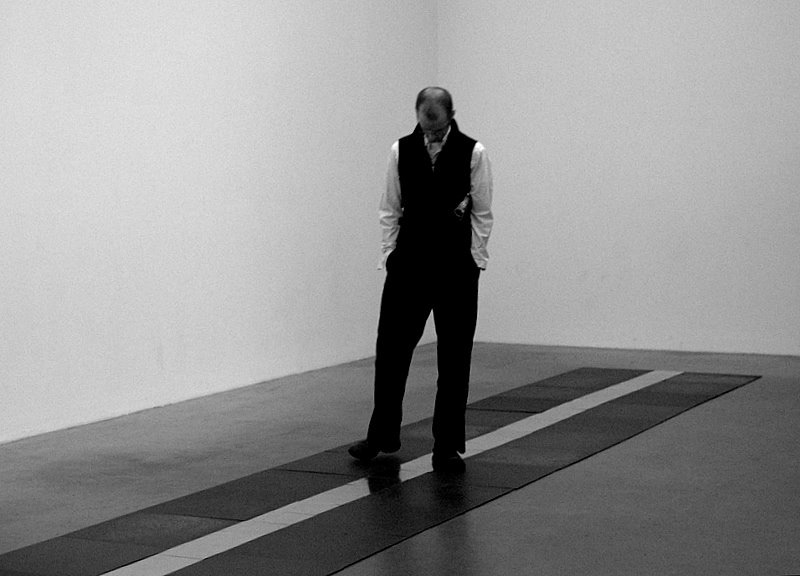
Carl Andre (1935). Venus Forge (1980). Image from Elspeth Briscoe via Flickr
Ab-Ex & Action Painters
On the first major American movement in modern art history.
American artwork prior to and during World War II was heavily defined by two central movements: regionalism and social realism. Value lay in the subject matter and the accuracy of its representation. Abstract art was generally dismissed and held in lower regard by both art critics and the public. However, many artists began to oppose the traditional rules and standards, aided by an influx of refugee artists from Europe. Drawing on ideas of surrealism and automatism, abstract expressionism began to emerge, employing strategies not commonly seen in preexisting artwork. In his essay, The American Action Painters, Harold Rosenberg described these works as events, rather than pictures. The artists paint for the sake of painting, and the resulting works are extensions of themselves, depictions of their psyche, or portrayals of their emotions rather than representations of objects.
Action painters’ work was improvisational in nature, the canvas a direct result of their impulses. Jackson Pollock’s dripping and pouring of paint is the most common example. Pollock’s paintings incorporated not only untraditional methods but untraditional mediums as well. His work Full Fathom Five (1947) included debris, like matches, cigarettes, coins, buttons, keys, and tacks. Willem de Kooning, another of the most well-known names from this time, was a gestural artist like Pollock, though he often mixed abstract work with figurative imagery. His work is very reminiscent of Arshile Gorky, an artist who fled to America during the Armenian genocide. One of his largest and most notable works, The Liver is the Cock’s Comb, features his common destabilization of background and foreground incorporated with abstract figures seemingly emerging and disappearing into the surrounding color. de Kooning was heavily influenced by Gorky and employed many of these strategies in his own work, though his work featured more of an interest in distorted women and landscapes and tended to be more figurative than his contemporaries.
The violent nature of de Kooning’s work mocks the viewer’s desire to see beauty. Woman and Bicycle (1953) showcases these attributes. The female figure evokes a complicated reaction. She has leering eyes, and garish smile, and a mildly disfigured body that blends and mixes with the surrounding field to the point that it is hard to identify either foreground or background. This rejection of artistic standards and representation was polarizing in the art world, but nonetheless gained enough attention to become to first major American movement in modern art history.
“Medium” Qualifiers
How the concept of such evolved through the 1950s and 60s.
An art medium refers to the materials and techniques used for a piece of work. Prior to World War II, there was no lack of artistic mediums — paintings, drawings, dance, music, sculpture, and drama performances were common. Still, there existed conventions and an expectation for what would be presented and how the audience was to interact with it. In the 1950s and 60s, artists began to defy and disassemble these expectations. Lygia Clark strove to make art that would force her audience to be participants, rather than viewers. She saw art as a non-static, living organism, as demonstrated in her Bichos, (1960–66) assemblies made of hinged metal pieces that could be manipulated by the audience, and had no ideal form. Robert Rauschenberg also toyed with expectations, with a focus on process and material over user interaction. His work Bed (1955) contains no canvas — a pillow, sheet, and quilt serve as the base for splashes and drips of paint.
Another medium-defying artist was musician and composer John Cage. He realized that performances differed in ways out of his direct control; the audience and the variances in their reception became of great interest to him. His composition, 4’33” is silent. Instead of the audience witnessing the playing of an instrument, they are instead confronted by their own thoughts, their own reactions to silence, and the ambient noise of the crowd around them. This absence of traditional content can also be found in Rauschenberg’s work Erased de Kooning, which is exactly what the title describes and forces the viewer to see more than a nearly blank piece of paper. All of this work involves the viewer — blurring the line between creator and witness. These roles nearly disappear in “happenings”, a term coined by Allan Kaprow to describe a new method of artistic practice that involved dance, theater, music, poetry, and visual art, in which the participants were just as key as any other aspects. In his first showing, 18 Happenings in 6 Parts (1959), the audience was mobile and given simple instructions. By the time Kaprow put on Household (1964), the participants were the act: creating piles and nests, smearing and licking jam off a car, starting fires, and destroying each other’s creations. These artists all embraced the ways individuals participate in their work to the point where their work does not stand alone without it.
Minimalism
Looking beyond “I could do that”.
Minimalism overturned many pre-existing conceptions of what constitutes art and artistic processes. Within the context of minimalist art, hands-on creation is irrelevant, whether this be an act of seemingly simple assembly or even a completely outsourced creation. Rather, it is the artist’s idea and initiative at the conception of the work, and the curation once it is done, that matter. Viewer activation and involvement are highlighted. In Robert Morris’s Notes on Sculpture, he states that the environment containing the work is a factor in the object-subject relationship, because it defines the viewer’s spacial relation to the object, and hence their changing perspectives. This dynamic can be seen in Morris’s work, particularly in his contribution to the Primary Structures show in the Jewish Museum (1966). His three untitled L-beams seem uncomfortably large for the size of the gallery, necessitating the viewer maneuver around them. The nature of the exhibition space forces a consideration of one’s own body in relation to the work.
Another important contributor to minimalism was Carl Andre, who was intensely interested in work comprised of identical modular units. His work Equivalent V (1966–69) was an assembly of 120 fire bricks. These bricks were industrial, ready-made objects, meaning that no physical aspect of this piece was created by Andre, only the idea to procure and assemble them. The bricks lie without pedestal or plinth, propagating the idea that sculpture should define, rather than simply occupy, the space.
This idea is reiterated by Donald Judd, whose primary aspect of his work was space. 15 untitled works in concrete, located in Marfa, Texas, are concrete geometrical squares completed from 1980–84 occupying space on a 340 acre plot of land. Judd was enabled through the help of the Dia Art Foundation, which had an interest in creating space for artists outside of galleries. Marfa answered this need, providing plenty of acreage for both outdoor and indoor works to echo the empty landscape and exist alongside no other artwork. Judd’s work is permanently installed, and the nature of the location makes it a destination for people to visit, where they play the distinct role of guests. The sculpture defines the space to the point of becoming the space, and the viewer becomes the visitor rather than the spectator, activating their role in the experience and reworking the traditional and expected dynamic between human and art.
Bodily Experience
Using figure, figuratively. Or literally.
The bodily experience as an aspect and focus of artistic creation emerged across several genres in the 1960s and 1970s. For Louis Bourgeois, concepts of the body rise from her childhood and lived experiences. The art she creates is representative of herself and her life. In her 1988 interview with Donald Kuspit, she explained that modern art is about the painful situation of expressing oneself — the hurt of not being able to do that properly is the reason modern art exists. Resentment, hurt, and anxiety regarding familial tension informed her work which took organic, aggressive, and often sexually explicit shapes. She is known chiefly for her spiders — large, spindly, metal sculptures ranging in size — notably Maman (1999). The spiders, which she sees as clever, friendly, protective weavers and restorers are an ode to her mother. Maman looms over the viewer, the scale forcing an awareness of one’s size relative to the sculpture. As they look up at it, it looks predatory and poised, which can seem both fearfully overwhelming and fiercely protective.
For some artists, the bodily experience is taken in a much more literal way. Yoko Ono is a Japanese multimedia artist concerned with geopolitical events. She joined the art scene in New York and gained traction and renown for performances like Cut Piece (1964). This act begins with her sitting in her favorite outfit in a traditional Japanese position. Audience members are invited to come and cut pieces off her clothing, which they keep. There is more than one interpretation of her work, many see it as a statement on gender-based violence while others see it being representative of survivors of atomic bombings in Japan, emulating their tattered clothing and scars.
Another Japanese artist, Tetsumi Kudo, worked with ideas of the body in sculpture and found object assemblages, which incorporate lots of melting bodies, wax, and disintegration of the human subject. Portrait of an Artist (1975) is a cage containing a human head with red, tired eyes, and shredded, working hands. There is meaning in the choices of which body parts are displayed and which are forgone. The piece as a whole is a statement on being an artist, whose societal values lie only in the ideas and implementation the body is capable of creating, all while trapped in a metaphorical cage. The body is representative across all these works, to self reflect, highlight pain, or force perspective.